Texas LLC Franchise Tax & PIR Guide
Business & Legal Services, Texas LLC franchise tax, Texas public information report
Annual Franchise Tax and Public Information Report for Texas LLCs
If you own an LLC in Fort Worth, staying compliant with the Texas franchise tax and annual Public Information Report (PIR) is essential to protecting your company’s good standing. This guide explains how the annual LLC report in Texas works, what the Texas public information report includes, and how to avoid costly penalties and forfeiture.

What Is the Texas Franchise Tax?
The Texas franchise tax is the state’s primary business income tax, imposed on most taxable entities that do business in Texas, including LLCs, corporations, and certain partnerships. It is calculated on a business’s taxable margin, which is generally based on total revenue with specific deductions and calculations defined by the Texas Comptroller of Public Accounts (comptroller.texas.gov).
For report year 2026, the standard franchise tax rates are:
- 0.375% of taxable margin for retail or wholesale businesses.
- 0.75% of taxable margin for all other taxable entities.
While Texas does not impose a personal income tax on individuals, the franchise tax applies to business entities. That means a Fort Worth LLC may owe franchise tax even if its owners do not file a Texas personal income tax return.
Who Must File a Texas Franchise Tax Report?
Nearly all Texas LLCs are considered “taxable entities” and are subject to Texas comptroller filing requirements. If your LLC is organized in Texas, or does business in the state, you are generally required to file an annual franchise tax report and a Public Information Report (PIR) or Ownership Information Report (OIR), even if no tax is ultimately due (Texas Comptroller).
- Texas-organized LLCs: Must file annually as long as the entity exists, unless specifically exempt.
- Out-of-state LLCs registered in Texas: Must file if they have nexus or do business in Texas.
Certain entities, such as some passive investment partnerships or qualifying veteran-owned businesses in their first five years, may be exempt, but most small business LLCs in Fort Worth should assume they must file unless a professional confirms otherwise.
Key Deadline: May 15 Each Year
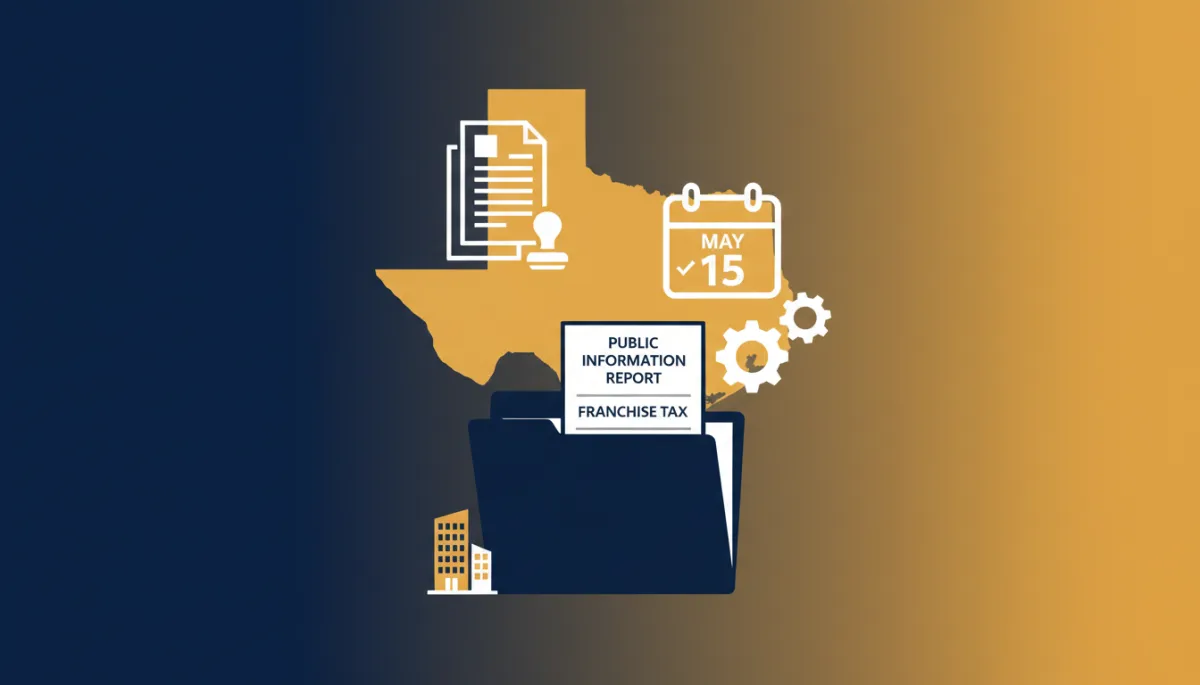
The annual franchise tax report and the Texas public information report are generally due by May 15 of each year. For the 2026 report year, the due date is May 15, 2026. If May 15 falls on a weekend or legal holiday, the due date moves to the next business day (comptroller.texas.gov).
Extensions are available if requested properly, but penalties and interest can apply if tax is ultimately due and not paid on time. Even if your Fort Worth LLC owes no franchise tax because of the no-tax-due threshold, missing the May 15 filing of your PIR can still jeopardize your company’s status.
How the No Tax Due Threshold Works
Texas provides a no-tax-due threshold so smaller entities do not owe franchise tax. For reports covering 2024 and 2025, the threshold is $2,470,000 in annualized total revenue. Beginning with the 2026 and 2027 report years, the threshold increases to $2,650,000 (Texas Comptroller notices).
- If your LLC’s annualized total revenue is at or below the threshold, you owe no franchise tax.
- Starting with 2024 reports, entities below the threshold generally do not file a separate “No Tax Due” report, but they must still submit a PIR or OIR (comptroller.texas.gov).
For many Fort Worth LLC owners, this means you may not owe any franchise tax because your revenue is under the threshold, yet you still have an annual filing obligation. Ignoring these filings because “we don’t owe tax” is one of the most common and most expensive compliance mistakes.
EZ Computation vs. Long Form vs. Public Information Report
When your LLC’s revenue exceeds the no-tax-due threshold, you must calculate and pay franchise tax using one of the available computation methods and also file the required ownership report. The main options are:
- EZ Computation Report: Available if your total revenue is at or below $20 million. This method uses a simplified calculation and a single rate (0.331% for 2026 reports), but you forgo certain deductions. It is designed to make Texas comptroller filing easier for small and mid-sized businesses.
- Long Form Report: Required if you are not eligible for EZ computation or if you choose to use the standard margin methods. This report is more detailed and allows different margin calculations, such as total revenue minus cost of goods sold or compensation, within statutory limits (2026 franchise forms).
- Public Information Report (PIR) or Ownership Information Report (OIR): These are information-only reports that list your entity’s key details and ownership. They must be filed in addition to your tax report, whether you use EZ computation, the long form, or qualify for franchise tax no tax due Texas treatment.

Different Texas franchise tax forms serve separate purposes but share the same deadline.
What Is the Public Information Report (PIR)?
The Public Information Report is an annual disclosure filed with the Texas Comptroller that provides basic information about your entity’s structure and management. For Texas LLCs, the PIR typically includes:
- The LLC’s legal name and mailing address.
- The Texas taxpayer number assigned by the Comptroller.
- Names, titles, and addresses of managers, members, officers, or directors, depending on the entity type (Texas franchise tax).
The PIR is used to keep the state’s public records current and to coordinate information between the Comptroller and the Texas Secretary of State. It does not calculate tax, but it is still mandatory as part of the annual LLC report Texas requires for most entities.
Why Every Texas LLC Must File the PIR, Regardless of Revenue
Whether your Fort Worth LLC has $50,000 in revenue or $5 million, the PIR (or OIR, for certain unincorporated entities) is required each year unless you fall into a narrow exemption category. The obligation to file the PIR is separate from the obligation to pay franchise tax.
- Below the no-tax-due threshold? You may not owe tax, but you still file the PIR.
- Above the threshold? You file a tax report (EZ or long form) and the PIR.
This is why many professionals refer to the PIR as part of the “annual franchise tax and public information report package.” Focusing only on whether you owe tax can cause you to overlook this critical filing, putting your LLC at risk even when you have no tax liability.
Consequences of Missing the PIR or Franchise Tax Filing
Failure to file your franchise tax report and PIR on time can trigger penalties, interest, and more serious consequences. Over time, continued noncompliance can lead to:
- Loss of good standing: Your LLC may fall out of good standing with the state, which can affect contracts, financing, and the ability to obtain certificates of fact or status.
- Forfeiture of charter: Persistent failure to file can result in forfeiture of the LLC’s charter, effectively stripping the entity of its legal rights and protections.
- Personal exposure: In some cases, forfeiture can increase the risk that owners or managers are treated as personally liable for certain obligations that would otherwise belong to the LLC.
For Fort Worth LLC owners, this can also create local headaches: difficulty renewing city permits, confusion with lenders or landlords, and delays in closing deals if your entity status shows as “forfeited” or “not in good standing” when checked by a counterparty.
Practical Tips for Fort Worth Small Business Owners
Managing Fort Worth LLC taxes does not have to be overwhelming. A few practical steps can keep your Texas comptroller filing on track and reduce the risk of surprises:
- Track total revenue monthly. Knowing where you stand relative to the no-tax-due threshold (currently $2.47 million, increasing to $2.65 million for 2026 reports) helps you anticipate whether you will owe franchise tax or simply file information-only reports.
- Keep ownership and officer records updated. Changes in managers, members, or addresses should be reflected promptly so your PIR is accurate when May 15 arrives.
- Use the Comptroller’s online system. Electronic filing reduces mailing delays and provides confirmation that your annual LLC report Texas requirements have been met.
- Coordinate with your income tax filings. For many Fort Worth businesses, the same financial data used for federal returns can support franchise tax calculations, especially when determining taxable margin or deciding between EZ computation and the long form.
- Consult a local professional. Texas franchise tax rules can change, as seen with the updated thresholds and 2026 computation adjustments. Working with a Fort Worth-based advisor who understands both state rules and local business realities can save time and reduce risk.
If you are unsure whether your LLC should use the EZ computation method, the long form, or how the franchise tax no tax due Texas rules apply to your situation, a short consultation can often clarify your options and prevent filing errors.
Staying current on the Texas LLC franchise tax and the annual Texas public information report is one of the simplest ways to protect the liability shield you formed your LLC to obtain. For Fort Worth owners who prefer to focus on running their business rather than deciphering forms, IKAR Tax and Investments Inc offers local, hands-on support with franchise tax and PIR compliance. Their Fort Worth office at 4200 South Fwy., Suite 2520, Fort Worth, TX 76115 works directly with area LLCs on Texas comptroller filing, annual LLC report Texas requirements, and related planning. You can learn more at https://ikartaxandinvestments.com, review their Google Business Profile, or call (817) 305-3433 to discuss your specific Fort Worth LLC taxes and reporting questions with a knowledgeable local team.
