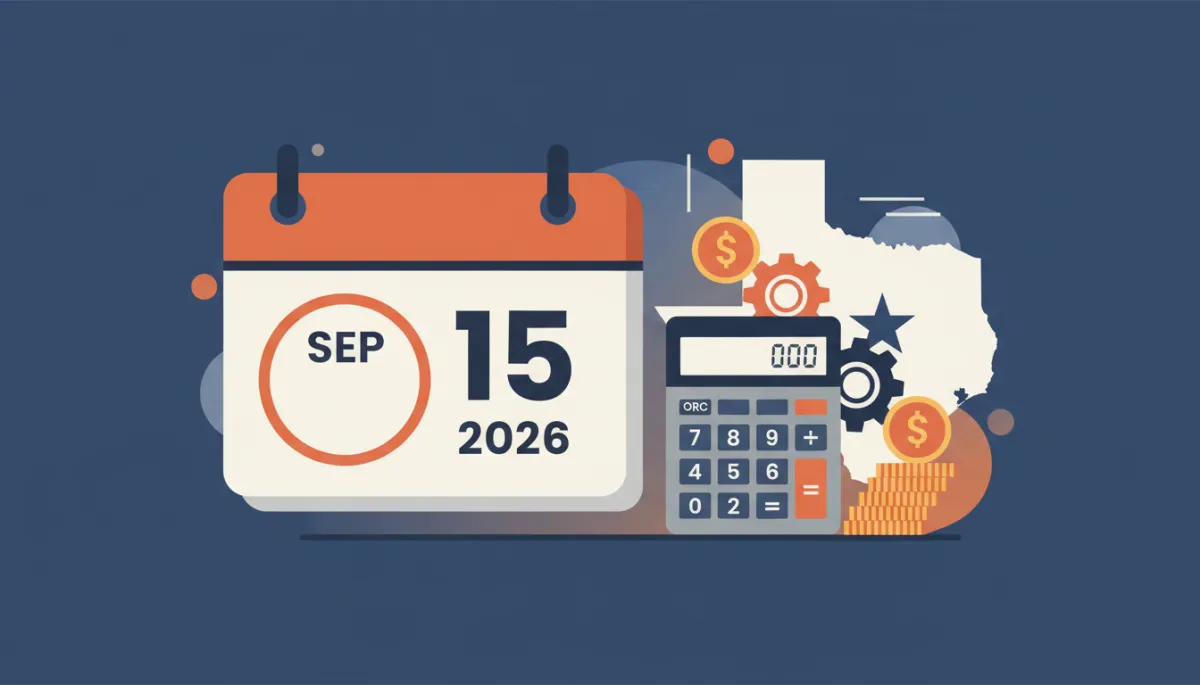
Quarterly Taxes for Self-Employed Texans
Taxes, Quarterly Estimated Taxes, Self-Employed, Fort Worth Texas
Quarterly Estimated Taxes: What Self-Employed Texans Need to Know Before the September 15 Deadline
For self-employed Texans in Fort Worth and across North Texas, the next big tax date is coming fast. The Q3 estimated tax payment for 2026 is due on September 15, 2026, and missing it can mean IRS penalties and interest — even if you ultimately pay in full by next April. Whether you are a 1099 contractor, rideshare driver, freelancer, or small business owner, understanding how quarterly estimated taxes work can help you avoid surprises and keep more of your hard-earned income.

Who Must Pay Quarterly Estimated Taxes?
The IRS expects tax to be paid as you earn income, not just once a year. For traditional employees in Fort Worth, this happens automatically through paycheck withholding. But if you are self-employed, there is usually no withholding — which is where quarterly estimated taxes come in.
You generally need to make estimated payments if both of the following are true:
- You expect to owe at least $1,000 in tax for the year after subtracting withholding and refundable credits, and
- Your withholding and credits will be less than the smaller of 90% of your 2026 tax or 100% (110% for higher earners) of your 2025 tax.
In practical terms, if most of your income comes on a Form 1099 or through business profits, you are likely responsible for IRS quarterly tax payments. This includes:
- Freelancers and consultants (designers, writers, IT professionals, marketing specialists, and more)
- Rideshare and delivery drivers, and other gig workers using platforms like Uber, Lyft, DoorDash, or Instacart in Fort Worth and surrounding cities
- Independent contractors in construction, real estate, health care, and professional services across North Texas
- Single-member LLC owners and partners in multi-member LLCs whose profits flow through to their personal tax returns
The Four IRS Quarterly Due Dates for 2026
For calendar‑year taxpayers — which includes most self‑employed individuals in Texas — the IRS sets four payment deadlines each year. For 2026, the IRS quarterly estimated tax due dates are:
| Period Covered | 2026 Due Date |
|---|---|
| January 1 – March 31, 2026 (Q1) | April 15, 2026 |
| April 1 – May 31, 2026 (Q2) | June 15, 2026 |
| June 1 – August 31, 2026 (Q3) | September 15, 2026 |
| September 1 – December 31, 2026 (Q4) | January 15, 2027 |
The upcoming Q3 estimated tax payment is especially important because it covers your busy summer months. If your Fort Worth business had higher‑than‑usual income from June through August — for example, seasonal construction projects, wedding photography, or tourism‑related work — your September 15 payment may need to be larger to stay on track.
How to Calculate Your Quarterly Tax Estimate
Estimating your quarterly payments can feel intimidating, but you do not need a complex estimated tax calculator to get started. The IRS provides worksheets in Form 1040‑ES, and a Fort Worth tax professional can refine the numbers for your specific situation. At a high level, here is what you need to consider.
Step 1: Estimate Your Annual Income and Deductions
Project your total income for 2026 from all sources: business profits, 1099 income, side gigs, rental income, and investments. Then subtract expected deductions — such as business expenses, retirement contributions, and health insurance premiums — to estimate your taxable income. Form 1040‑ES walks you through this process in a structured way, using current IRS rules and tax brackets.
Step 2: Include Self‑Employment Tax (15.3%)
If you are self‑employed, you must pay both income tax and self‑employment tax. Self‑employment tax covers Social Security and Medicare for self‑employed individuals and is generally 15.3% of your net self‑employment income, subject to annual Social Security wage limits. This amount is added on top of your regular federal income tax when calculating quarterly payments.
Step 3: Apply the Safe Harbor Rule
To avoid underpayment penalties, many Fort Worth business owners use the IRS safe harbor rule. You are generally protected from penalties if your total payments for 2026 are at least:
- 90% of the tax you will owe for 2026, or
- 100% of your 2025 tax (110% if your 2025 adjusted gross income was more than $150,000).
For many self‑employed Texans whose income fluctuates, paying one‑quarter of last year’s total tax bill each quarter is a straightforward way to meet safe harbor. Others prefer to adjust payments based on current‑year income, especially if business is growing quickly in North Texas.
Step 4: Divide and Pay Using Form 1040‑ES
Once you estimate your total 2026 tax, divide by four to find your quarterly payment amount. You can pay electronically via IRS Direct Pay, through your IRS online account, or by mail using the vouchers in Form 1040‑ES. If you need help aligning your numbers with your actual bookkeeping, a self‑employed tax Fort Worth specialist can ensure your estimates are accurate before the September 15 tax deadline.
What Happens If You Miss or Underpay?
Ignoring quarterly payments does not make the tax go away — it simply adds cost. If you miss the September 15 tax deadline or pay too little, the IRS can assess underpayment penalties and interest, calculated separately for each quarter. These charges are based on how much you underpaid and for how long, using an interest rate that adjusts quarterly and can add up over a busy year in business.
Even if you receive a refund when you file your 2026 return, you could still owe underpayment penalties if your payments were not made evenly or on time throughout the year. That is why staying current with each Q3 estimated tax payment and the other quarters is so important for self‑employed Texans and Fort Worth LLC owners alike.
Deductions That Can Reduce Your Estimated Tax Bill
One of the best ways to manage quarterly estimated taxes Texas‑wide is to make sure you are claiming every deduction you are entitled to. Lower taxable income means lower required estimates — and less strain on your cash flow in Fort Worth.

Flat of tax documents and forms, a magnifying glass over a checklist, an upward trending chart,...
Home Office Deduction
If you regularly and exclusively use part of your home in Fort Worth for business — whether it is a dedicated room or a clearly defined area — you may qualify for the home office deduction. You can use the simplified method (a flat rate per square foot) or the actual‑expense method, which allocates a portion of mortgage interest or rent, utilities, and maintenance to your business use.
Vehicle and Mileage Expenses
Many North Texas self‑employed professionals log substantial miles visiting clients, job sites, or vendors. You can generally choose between deducting actual vehicle expenses (gas, repairs, insurance, depreciation) or using the IRS standard mileage rate. Good mileage logs make it much easier to support your deduction if ever questioned.
Health Insurance Premiums and Retirement Contributions
If you pay for your own health insurance as a self‑employed Texan, those premiums may be deductible, reducing both your annual tax and your quarterly estimates. Contributions to tax‑advantaged retirement plans such as a SEP‑IRA or Solo 401(k) can also significantly lower taxable income, particularly for higher‑earning Fort Worth business owners planning ahead for retirement.
Ordinary and Necessary Business Expenses
Do not overlook everyday business costs: software subscriptions, advertising, professional fees, supplies, equipment, and a portion of business meals. Properly categorized expenses in your accounting system feed directly into your tax return and your quarterly estimate calculations. Working with a Fort Worth tax professional can help ensure you are not leaving money on the table each quarter.
Texas-Specific Advantage: No State Income Tax
One major advantage for self‑employed Texans is that the state does not levy a personal income tax. That means your quarterly payments relate only to federal income and self‑employment taxes, unlike freelancers in many other states who must juggle both federal and state estimated payments. However, Texas businesses may still face other obligations — such as the Texas franchise tax for certain entities — so it is important to view your situation holistically rather than assuming “no state income tax” means “no state tax responsibilities.”
Even without state income tax, federal quarterly estimates remain critical. Underpaying throughout the year can still result in penalties and a large April balance due, which can strain cash flow for Fort Worth LLC owners and independent contractors alike.
Tips to Stay on Top of Quarterly Taxes Year-Round
The most effective way to manage 1099 contractor taxes Texas‑wide is to build tax planning into your regular business routine. Here are practical strategies that work well for many self‑employed professionals across Fort Worth and North Texas.
- Set aside 25–30% of each payment. When income hits your business account, immediately move a portion into a separate tax savings account. For many self‑employed individuals, 25–30% is a reasonable starting point, though your exact percentage depends on your deductions and income level.
- Open a dedicated tax savings account. Keeping tax funds separate from operating cash reduces the temptation to spend money earmarked for your next IRS quarterly tax payment, especially as the September 15 deadline approaches.
- Use accounting software. Cloud‑based bookkeeping tools can categorize income and expenses, generate profit‑and‑loss reports, and make it easier to project your quarterly liability. Accurate records are the foundation of reliable estimates.
- Schedule tax check‑ins. Mark your calendar a few weeks before each due date — including the upcoming September 15, 2026 Q3 deadline — to review income year‑to‑date and adjust payments as needed. Treat these dates like any other critical client or vendor deadline.
- Partner with a professional. Working with a local advisor who understands self‑employed tax Fort Worth issues can help you interpret IRS rules, optimize deductions, and avoid costly missteps. Firms like IKAR Tax and Investments Inc keep up with IRS publications such as Publication 505 and Form 1040‑ES instructions so you can focus on running your business.
If you are unsure how much to pay for your Q3 estimated tax payment, it is far better to ask questions now than to wait until next spring. A brief planning conversation can prevent both penalties and unnecessary overpayments.
As the September 15, 2026 deadline approaches, taking a proactive approach to quarterly estimated taxes Texas‑wide can keep your business on solid financial footing. Whether you operate a small LLC near downtown Fort Worth, drive for rideshare services across North Texas, or consult with clients statewide, having a clear plan for IRS quarterly tax payments is essential. IKAR Tax and Investments Inc works with self‑employed individuals, 1099 contractors, and business owners to align bookkeeping, deductions, and estimates, using tools more precise than a generic estimated tax calculator. You can learn more about their services at https://ikartaxandinvestments.com, explore reviews and location details on their Google Business Profile, or visit their conveniently located Fort Worth office at 4200 South Fwy., Suite 2520, Fort Worth, TX 76115. If you would like tailored guidance before the Q3 deadline, you can call (817) 305-3433 to speak with their team or schedule time through the website at IKAR Tax and Investments, and move into the rest of 2026 with more confidence in your tax planning.
