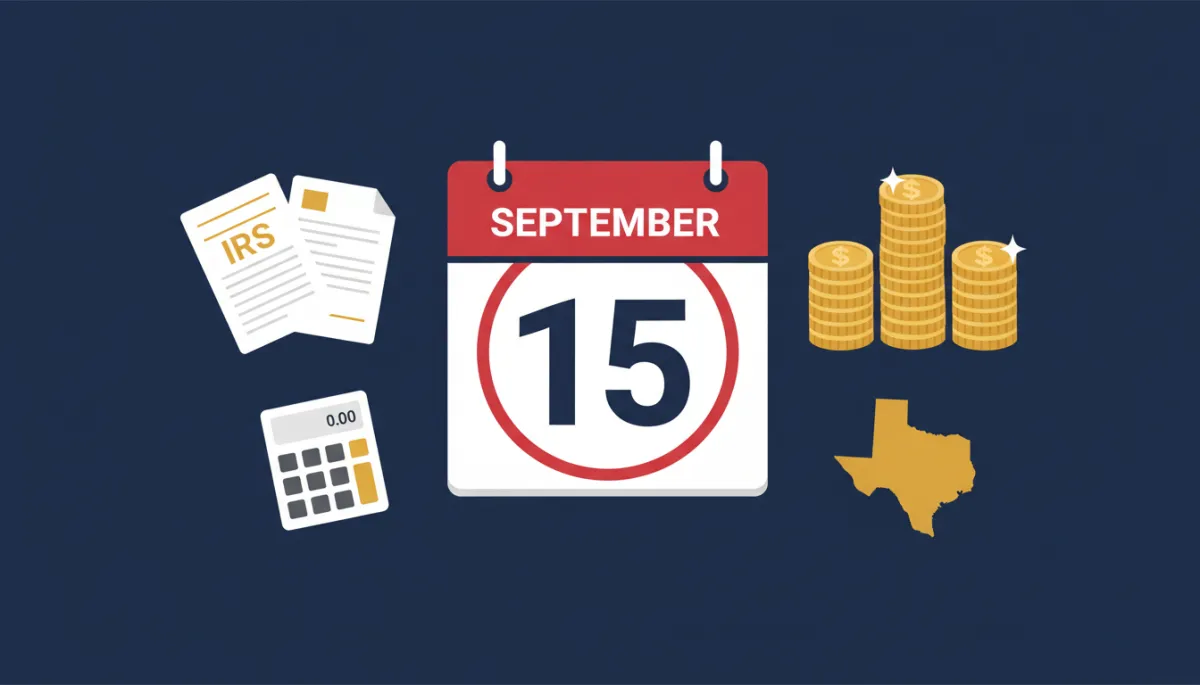
Quarterly Estimated Taxes for Self-Employed Texans: What Fort Worth Freelancers Need to Know Before September 15
If you're self-employed in Fort Worth — whether you're a freelance graphic designer in the Cultural District, an independent contractor working energy sector projects across Tarrant County, or a gig economy worker juggling rideshare and delivery apps — you already know that running your own business comes with extraordinary freedom. What catches many Fort Worth entrepreneurs off guard, however, is the quarterly estimated tax obligation that comes with that independence. Unlike traditional employees who have taxes automatically withheld from every paycheck, self-employed workers are responsible for sending the IRS their own tax payments four times a year. With the third-quarter deadline falling on September 15, 2026, now is exactly the right time to make sure you're on track — and ahead.
Who Needs to Pay Quarterly Estimated Taxes in Texas?
The IRS requires you to pay quarterly estimated taxes if you expect to owe at least $1,000 in federal income tax for the year after subtracting withholding and refundable credits. This rule applies to a wide range of Fort Worth workers, including:
- Freelancers and independent contractors in any industry
- Gig economy workers — rideshare drivers, delivery couriers, and app-based service providers
- Sole proprietors and single-member LLC owners
- Real estate investors and landlords collecting rental income in Tarrant County
- Partners in a business partnership
- S-corporation shareholders who receive distributions beyond a regular salary
Texas has no state income tax — one of the most significant financial advantages of building a career or business in the Lone Star State. However, you remain fully responsible for federal income tax and self-employment (SE) tax, which covers your Social Security and Medicare contributions at a combined rate of 15.3% on net self-employment earnings. For many Fort Worth freelancers and small business owners, SE tax alone can represent a substantial portion of each quarterly payment.
If you're uncertain whether your income level triggers the quarterly payment requirement, the professionals at IKAR Tax and Investments can quickly evaluate your situation and help you build a sensible payment plan. Reach their Fort Worth office directly at (817) 305-3433.
The Four Quarterly Deadlines You Cannot Afford to Miss
The IRS divides the tax year into four payment periods. Missing these deadlines — or underpaying — can result in penalties even if you ultimately receive a refund when you file your annual return. For the 2026 tax year, the quarterly estimated tax due dates are:
- Q1 (January 1 – March 31): Payment due April 15, 2026
- Q2 (April 1 – May 31): Payment due June 16, 2026
- Q3 (June 1 – August 31): Payment due September 15, 2026
- Q4 (September 1 – December 31): Payment due January 15, 2027
Notice that the tax periods are not evenly spaced — the second quarter covers only two months, which frequently surprises first-time self-employed filers. Mark these dates in your calendar, set a recurring reminder, or work with a local Fort Worth tax professional who can help you track deadlines and plan payments proactively throughout the year.

How to Calculate Your Quarterly Estimated Tax Payment
Accurate calculation is essential. Underpay too much and you'll face an IRS penalty; overpay and you're effectively giving the government an interest-free loan until your refund arrives in April. Here's how to approach the math with confidence.
The Safe Harbor Rule — Your Built-In Protection
The simplest way to avoid underpayment penalties is to use the IRS safe harbor rule. You will not be penalized as long as you pay either:
- 100% of last year's total tax liability (or 110% if your prior-year adjusted gross income exceeded $150,000), or
- 90% of this year's actual tax liability
For most Fort Worth self-employed workers — especially those with variable or seasonal income — the prior-year safe harbor method offers the most predictable path. Simply locate your total tax amount from your 2025 Form 1040, divide by four, and pay that amount each quarter. If your income has grown significantly in 2026, calculating based on 90% of this year's projected liability may produce a more accurate and efficient payment strategy.
Using IRS Form 1040-ES
IRS Form 1040-ES (Estimated Tax for Individuals) includes a detailed worksheet that walks you through projecting current-year income, applicable deductions, and credits. Key inputs include:
- Projected gross self-employment revenue
- Eligible business deductions — home office, vehicle mileage, equipment, software subscriptions, and professional development costs
- The SE tax deduction: you may deduct half of your self-employment tax from gross income before calculating your income tax base
- Applicable credits such as the Child Tax Credit or education-related deductions
You can submit quarterly payments electronically through IRS Direct Pay or the Electronic Federal Tax Payment System (EFTPS) — both free of charge and available around the clock. There's no excuse to miss a deadline when payment is just a few clicks away.
What Happens If You Underpay or Miss a Deadline?
Missing a quarterly deadline or underpaying does not trigger an immediate IRS notice the way a missed annual filing might. Instead, the underpayment penalty is calculated when you file your annual return. It is based on the federal short-term interest rate plus 3 percentage points, applied to the underpayment amount for each day it remained outstanding.
While the daily penalty rate may seem modest, it accumulates across multiple underpaid quarters and can add up to a meaningful balance by the time you file in April. More importantly, if you haven't been setting aside funds quarterly, you may face a large and unexpected lump-sum payment at tax time — a cash-flow crisis that puts real pressure on small Fort Worth businesses and freelance households. Proactive quarterly planning is always less expensive than reactive damage control come spring.

Practical Strategies to Stay Ahead of Quarterly Taxes in Fort Worth
Open a Dedicated Tax Savings Account
One of the most effective habits for the self-employed is to open a separate savings account reserved exclusively for taxes. Each time you receive a client payment or platform payout, immediately transfer a fixed percentage — typically 25% to 30% of net income — into this account. This removes the temptation to spend funds that legally belong to the IRS and ensures you're never scrambling when a quarterly deadline arrives.
Track Every Business Expense Consistently
Your taxable self-employment income is your net income — revenue minus legitimate business expenses. Every deductible cost matters: the mileage you drive to client meetings across Tarrant County, your software subscriptions, professional development courses, equipment purchases, and qualifying home office square footage all reduce your taxable income — and therefore your quarterly payment. Consistent bookkeeping throughout the year is not optional; it is the financial foundation that accurate estimated tax payments rest on.
Leverage Retirement Accounts to Reduce Your Tax Burden
Fort Worth self-employed workers have access to powerful retirement accounts that also function as tax-reduction tools. A SEP-IRA allows contributions of up to 25% of net self-employment income (maximum $69,000 for 2026). A Solo 401(k) enables both employee and employer contributions, offering even greater deduction potential. These contributions are fully deductible, meaningfully lowering both your quarterly estimated tax and your year-end liability — while simultaneously building the retirement security that no employer pension will provide.
Partner with a Local Fort Worth Tax Professional
Quarterly estimated taxes involve real, detailed math: projecting income, identifying deductions, applying the safe harbor rule, and staying current across four annual deadlines. For busy Fort Worth freelancers and business owners focused on growing their craft or client base, working with a knowledgeable local tax professional is an investment that routinely pays for itself in avoided penalties, maximized deductions, and hours of time returned to your business.
IKAR Tax and Investments Inc. specializes in serving Fort Worth families and small business owners, with deep expertise in self-employment taxes, quarterly planning, bookkeeping, and year-round financial strategy. Their office is conveniently located at 4200 South Fwy., Suite 2520, Fort Worth, TX 76115 — right in the heart of the community they serve. You can also explore their services and read client reviews on their Google Business Profile.
With the Q3 estimated tax deadline of September 15, 2026 closing in fast, Fort Worth self-employed workers and entrepreneurs cannot afford to wait. Whether you need help calculating your Q3 payment from scratch, getting caught up on a missed quarter, or building a year-round tax strategy that genuinely fits your income pattern, IKAR Tax and Investments is ready to guide you through every step. Call (817) 305-3433 today — because the most expensive tax mistake a Fort Worth freelancer can make is the one they were simply too busy to prevent.
