Quarterly Estimated Taxes for Self-Employed Texans: What Fort Worth Freelancers and Business Owners Must Know
If you're a freelancer, independent contractor, rideshare driver, or small business owner in Fort Worth, you may have already filed your April return — but your tax obligations don't stop there. The IRS requires millions of self-employed Americans to pay taxes not once a year, but four times. Missing quarterly estimated tax deadlines can mean unexpected penalties at filing time, and many Fort Worth entrepreneurs discover this the hard way during their first year working for themselves.
With Q3's deadline on September 15, 2026 just around the corner, now is the ideal moment to understand exactly how quarterly estimated taxes work, whether you owe them, and how to stay ahead of your obligations for the rest of the year.

What Are Quarterly Estimated Taxes?
When you work as a traditional employee, your employer withholds federal income tax from each paycheck and sends it to the IRS throughout the year. But when you're self-employed — whether you're a sole proprietor, single-member LLC, gig worker, or freelance professional — no one withholds taxes on your behalf. You're responsible for calculating and remitting them yourself, on a quarterly schedule.
The IRS refers to these as "estimated tax payments," and they cover two key obligations: federal income tax and self-employment tax (SE tax). Unlike employees who split Social Security and Medicare taxes with their employer, self-employed individuals pay both sides — a combined rate of 15.3% (12.4% for Social Security on the first $168,600 of net earnings in 2026, plus 2.9% for Medicare on all net earnings). This SE tax component alone surprises many first-year Fort Worth freelancers.
Do You Actually Need to Pay Quarterly?
Not everyone who earns self-employment income is required to make estimated payments. The IRS sets two thresholds you need to know:
- You must file a return if your net self-employment income exceeds $400 in a year.
- You must make quarterly estimated payments if you expect to owe at least $1,000 in federal tax after subtracting withholding and credits.
If your only income is from self-employment and you earn more than a few thousand dollars per year, it's very likely you'll hit the $1,000 threshold. The safest assumption for most Fort Worth freelancers and contractors: if you're earning income on a 1099 basis, you should be paying quarterly.
Not sure where you fall? The team at IKAR Tax and Investments helps Fort Worth self-employed professionals determine their exact obligations so they're never caught off guard. Call (817) 305-3433 to speak with someone who understands the real-world tax picture for Texas contractors and gig workers.
The 2026 Quarterly Estimated Tax Deadlines
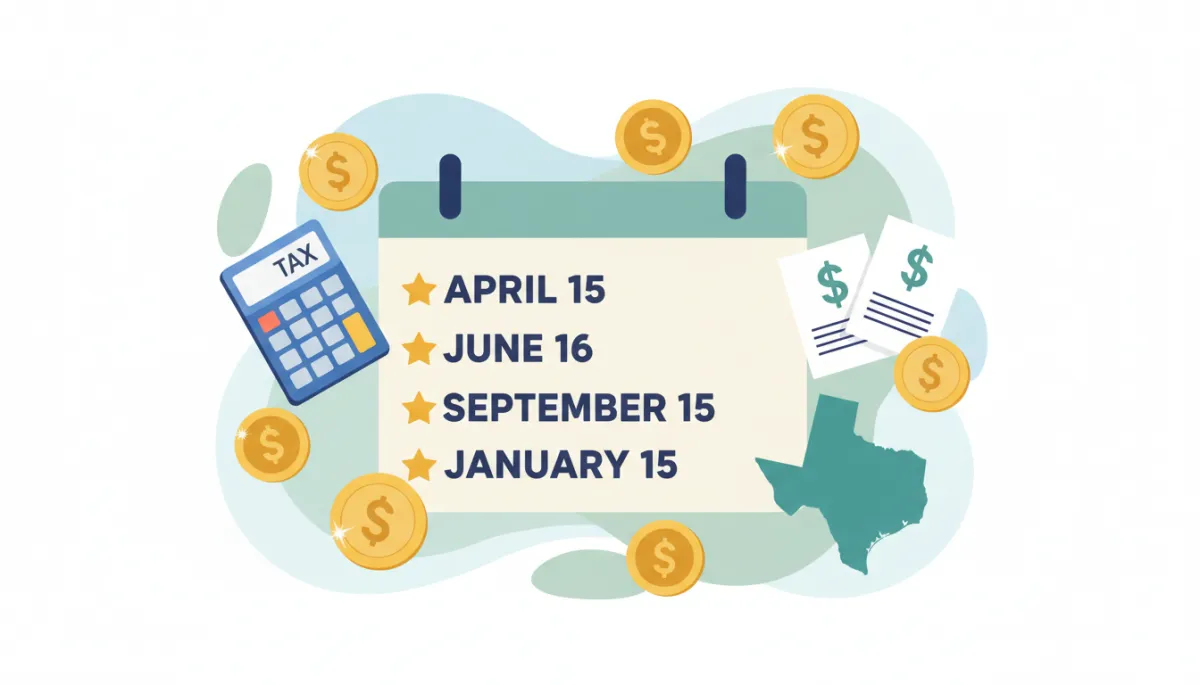
Many people assume quarterly taxes line up with calendar quarters — but they don't. Here are the actual IRS deadlines for 2026:
- Q1 (January 1 – March 31): Due April 15, 2026
- Q2 (April 1 – May 31): Due June 16, 2026
- Q3 (June 1 – August 31): Due September 15, 2026
- Q4 (September 1 – December 31): Due January 15, 2027
Note that Q2 covers only two months, and its deadline falls in mid-June rather than early July. This is a common source of confusion that catches many Fort Worth entrepreneurs off guard and results in a late-payment penalty. Mark these dates now — especially September 15, the next major deadline ahead for Texas self-employed workers.
How to Calculate What You Owe
The IRS provides Form 1040-ES, which includes a worksheet to help you estimate your annual tax liability and divide it into four equal installments. But the calculation involves more than simply multiplying your income by a rate. You'll need to account for:
- Net self-employment income (gross income minus allowable business expenses)
- The SE tax deduction — you can deduct half of your self-employment tax when calculating adjusted gross income
- The qualified business income (QBI) deduction, which many Fort Worth sole proprietors and single-member LLCs qualify for (up to 20% of qualified business income)
- Standard deduction or itemized deductions
- Any applicable tax credits (Child Tax Credit, Earned Income Tax Credit, education credits, etc.)
A widely used rule of thumb for Texas self-employed workers is to set aside 25–30% of net income for federal taxes. Texas levies no state income tax — a genuine financial advantage for Fort Worth freelancers — but federal obligations apply in full. The absence of state tax does not reduce your federal SE tax or income tax liability by one cent.

The IRS Safe Harbor Rule — Your Best Protection Against Penalties
Estimating your exact liability mid-year is difficult, especially when your income fluctuates from project to project. Fortunately, the IRS offers a "safe harbor" provision that protects you from underpayment penalties even when your quarterly estimates weren't perfect:
- Pay at least 90% of your current year's actual tax liability, OR
- Pay 100% of last year's total federal tax liability (110% if your prior-year AGI exceeded $150,000)
If you meet either threshold across all four quarters, you won't owe a penalty — even if you owe a balance at filing time. Many Fort Worth entrepreneurs use the prior-year safe harbor as their baseline: simply divide last year's total federal tax by four and pay that amount each quarter. It's a reliable, predictable strategy for years when income is variable.
Common Mistakes Fort Worth Freelancers Make
Certain missteps show up repeatedly among self-employed Texans navigating quarterly taxes for the first time. Here are the costliest ones to avoid:
- Not paying quarterly at all — assuming the April return is the only federal tax deadline
- Forgetting self-employment tax — calculating only income tax and ignoring the 15.3% SE component
- Misreading the quarter schedule — missing the short Q2 window and accidentally paying late
- Not deducting business expenses first — estimated payments must be based on net income, not gross receipts
- Skipping a quarter after a slow month — income variability doesn't pause the obligation; it requires recalculating your estimate
- Mixing personal and business finances — making it nearly impossible to accurately identify deductible expenses at year-end
How to Stay Organized Mid-Year
July is a natural financial checkpoint. You're halfway through 2026 and still have enough runway to course-correct before Q3 and Q4 compound any issues. Here's what Fort Worth self-employed workers should do right now:
- Reconcile income and expenses through June 30 using bank statements, invoices, and bookkeeping records.
- Calculate your net profit to date and project it forward to estimate your full-year tax liability.
- Review your Q1 and Q2 payments — if you underpaid, consider a voluntary catch-up payment before September 15.
- Open a dedicated tax savings account and automate transfers of 25–30% of every payment you receive into it.
- Document all business expenses — vehicle mileage, home office, software subscriptions, professional development, equipment, and health insurance premiums. Every legitimate deduction reduces your taxable net income and shrinks your quarterly obligation.
If your bookkeeping has slipped in the first half of 2026, there's still time to get current. Visit IKAR Tax and Investments on Google to see what Fort Worth clients say about their experience getting organized mid-year, or stop by the office at 4200 South Fwy., Suite 2520, Fort Worth, TX 76115.
How to Actually Make the Payment
Once you know what you owe, submitting your quarterly estimated payment is straightforward. The IRS accepts payments through several channels:
- IRS Direct Pay — free direct debit from your bank account at irs.gov
- Electronic Federal Tax Payment System (EFTPS) — particularly useful for businesses with recurring quarterly obligations
- IRS2Go mobile app — a convenient on-the-go option
- Check or money order — mailed with a completed Form 1040-ES payment voucher
Always specify the tax year and quarter when making a payment, so the IRS credits it to the correct period. A payment misapplied to the wrong quarter is almost as problematic as a missed one — and correcting it takes time you'd rather spend running your business.
Quarterly estimated taxes are one of the most manageable parts of self-employment once you understand the rules and build a consistent habit. At IKAR Tax and Investments Inc., the team works with Fort Worth freelancers, independent contractors, and small business owners throughout Tarrant County to take the guesswork out of quarterly obligations. Whether you need help calculating your Q3 payment, catching up on missed installments, or building a full-year tax strategy that keeps more money in your pocket, they're ready to help. Reach out at (817) 305-3433, explore their services at ikartaxandinvestments.com, or stop by 4200 South Fwy., Suite 2520, Fort Worth, TX 76115 — because getting your taxes right shouldn't wait until April.
