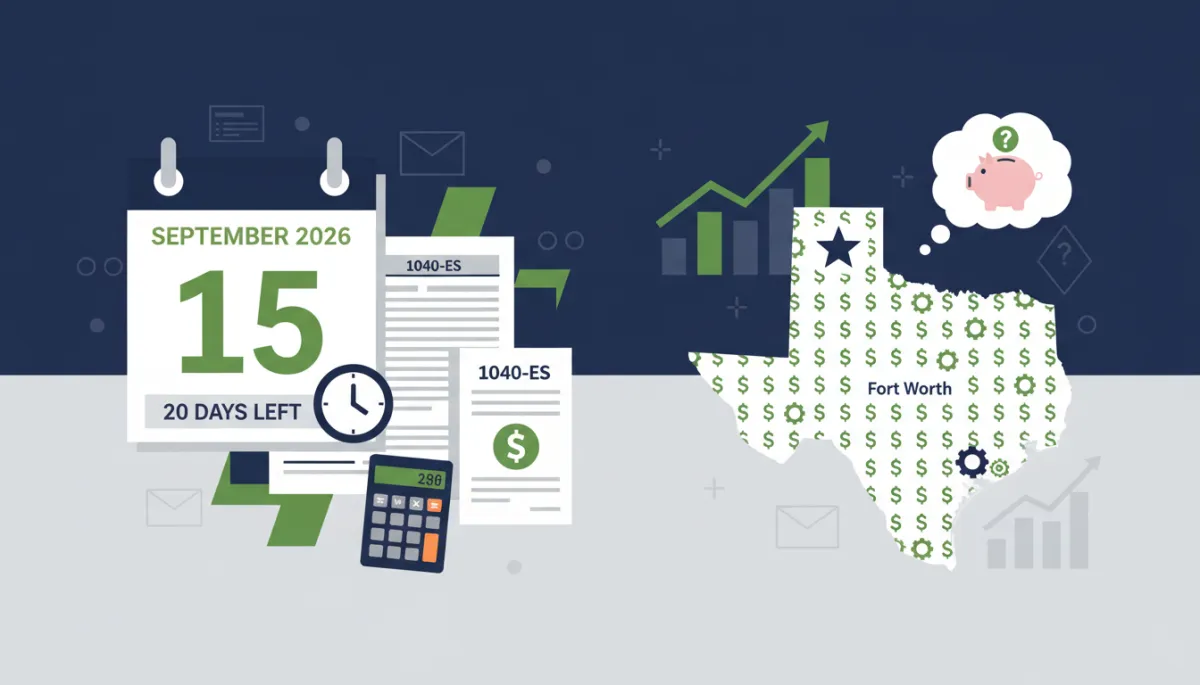
Q3 Estimated Taxes Due: Fort Worth Self-Employed Guide
Q3 Estimated Taxes Are Due September 15, 2026: A Fort Worth Guide for Self‑Employed Texans
For freelancers, gig workers, and small business owners across Fort Worth and Tarrant County, the Q3 federal quarterly estimated tax deadline on September 15, 2026 is just 20 days away. If you earn self‑employment income and don't have taxes withheld from a paycheck, now is the time to make sure your estimated payment is accurate, on time, and aligned with IRS rules for 2026.
What Quarterly Estimated Taxes Are — And Who in Texas Must Pay Them
Quarterly estimated taxes are advance payments of the federal income tax and self‑employment tax you expect to owe for the year. Instead of having taxes automatically withheld from a paycheck, self‑employed Texans are responsible for sending the IRS payments four times a year using Form 1040‑ES. These payments cover both income tax and the self‑employment tax that funds Social Security and Medicare, calculated on Schedule SE.
You generally need to pay quarterly estimated taxes if you expect to owe at least $1,000 in tax for 2026 after subtracting withholding and refundable credits. In Fort Worth, this commonly includes:
- Freelancers and independent contractors (designers, writers, consultants, IT professionals, and more)
- Gig workers using platforms like Uber, Lyft, DoorDash, Instacart, or similar apps in Fort Worth and surrounding Tarrant County communities
- Self‑employed professionals, including real estate agents, therapists, and tradespeople operating as sole proprietors or single‑member LLCs
- Small business owners whose income is not fully covered by payroll withholding
If this describes you and you are based in Fort Worth, Texas, the upcoming September 15, 2026 Q3 deadline is a critical date. Missing it can trigger underpayment penalties, even if you pay in full by next April.
The 2026 IRS Quarterly Estimated Tax Deadlines — With a Spotlight on Q3
For calendar‑year taxpayers, the IRS sets four quarterly estimated tax due dates each year. According to IRS guidance, the 2026 schedule for individuals, including self‑employed taxpayers in Texas, is:
| Income Period (2026) | Quarter | Payment Due Date |
|---|---|---|
| January 1 – March 31 | Q1 | April 15, 2026 |
| April 1 – May 31 | Q2 | June 15, 2026 |
| June 1 – August 31 | Q3 | September 15, 2026 |
| September 1 – December 31 | Q4 | January 15, 2027 |
The Q3 deadline on September 15, 2026 is especially important for Fort Worth freelancers because it covers your busy summer months. If you have had a strong season — for example, higher rideshare demand around local events or increased project work — your income for June through August may be significantly higher than earlier in the year. Adjusting your Q3 estimated payment now can help you avoid an unpleasant surprise and potential penalties when you file your 2026 return.
How to Calculate Your 2026 Estimated Tax: Safe Harbor, Schedule SE, and Form 1040‑ES
Use the Safe Harbor Rule to Avoid Penalties
The IRS offers a “safe harbor” rule that can protect you from underpayment penalties, even if your income fluctuates. In most cases, you will avoid penalties if you pay the smaller of:
- 100% of the total tax shown on your prior‑year return (110% for some higher‑income taxpayers), or
- 90% of the tax you expect to owe for the current year.
Many Fort Worth self‑employed taxpayers find it simplest to start with last year’s total tax and divide by four to get a baseline quarterly payment. If your 2026 income is trending higher, you can increase your Q3 payment ahead of the September 15 deadline to stay closer to the 90% current‑year target.
Don’t Forget Self‑Employment Tax on Schedule SE
Self‑employed workers in Texas must pay self‑employment tax in addition to income tax. This tax, reported on Schedule SE, covers both the employer and employee portions of Social Security and Medicare. For many Fort Worth freelancers, self‑employment tax is a significant part of the total bill, often around 15.3% of net earnings up to the Social Security wage base, plus Medicare on all net earnings.
When you use Form 1040‑ES to calculate your quarterly estimated taxes, make sure you include both your income tax and your self‑employment tax from Schedule SE. Ignoring self‑employment tax is one of the most common mistakes among new freelancers in Fort Worth and can lead to a painful balance due next spring.
Form 1040‑ES: Your Roadmap for IRS Estimated Payments in Texas
IRS Form 1040‑ES includes worksheets that walk you through estimating your 2026 income, subtracting business expenses, computing self‑employment tax, and determining your quarterly payment. While the form is the same nationwide, Fort Worth taxpayers should pay particular attention to their local business conditions — such as seasonal trends or major clients — when projecting income for the rest of the year ahead of the September 15 Q3 deadline.
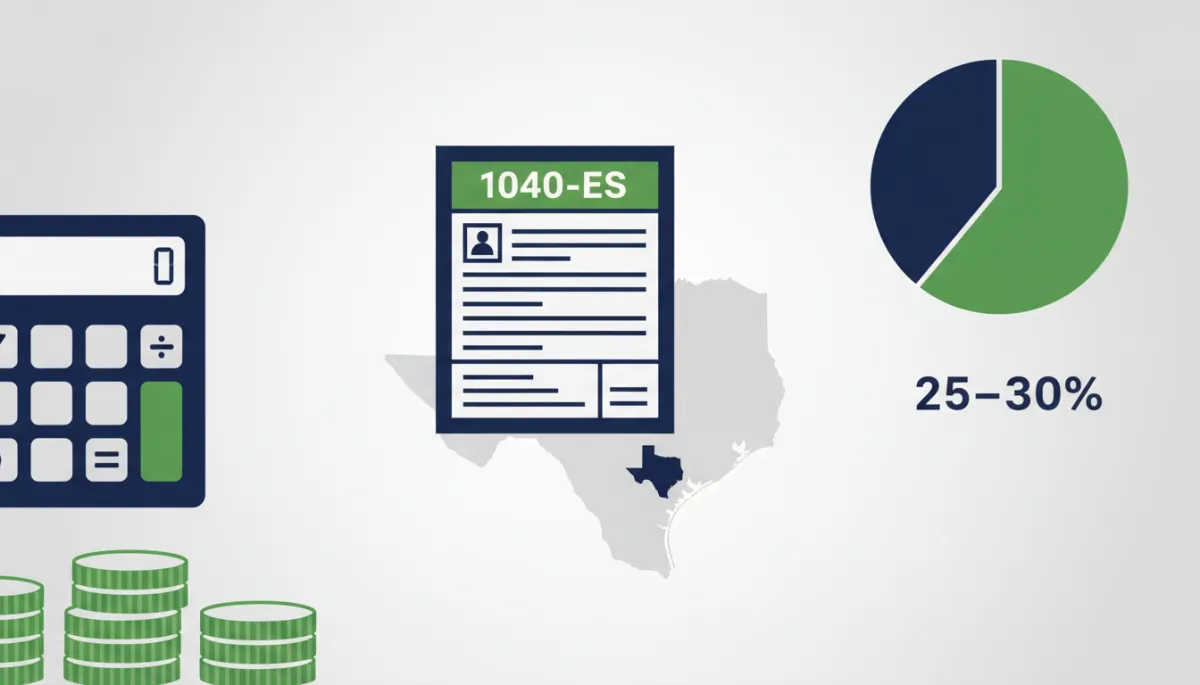
Setting aside 25–30% of self‑employment income helps Fort Worth freelancers meet quarterly tax deadlines.
How Fort Worth Self‑Employed Workers Can Pay Q3 Estimated Taxes
Once you have calculated your Q3 payment, you have several secure options to send it to the IRS before September 15, 2026. These methods are available to taxpayers throughout Texas and are especially convenient for busy Fort Worth professionals juggling clients, projects, and local commutes.
- IRS Direct Pay: Pay directly from your bank account at IRS.gov without creating an account. This is fast, free, and ideal if you are making a one‑time Q3 payment from your Fort Worth bank or credit union.
- EFTPS (Electronic Federal Tax Payment System): A secure, online system that lets you schedule payments in advance. Many Fort Worth small business owners use EFTPS to plan all four quarterly payments for the year and avoid last‑minute scrambles before deadlines.
- Mailing a Check with 1040‑ES Voucher: You can mail a check or money order with the appropriate Form 1040‑ES payment voucher. If you choose this option, allow extra mailing time from Fort Worth to the IRS processing center so your payment arrives by September 15, 2026.
Common Estimated Tax Mistakes Fort Worth Freelancers Should Avoid
Self‑employed taxpayers in Fort Worth face several recurring pitfalls when it comes to IRS estimated payments. With the Q3 deadline just 20 days away, reviewing these issues now can help you correct course before penalties accrue.
- Underpaying each quarter: Basing payments on optimistic deductions or low income estimates can leave you short. Use realistic projections, especially if 2026 has been a strong year for your Fort Worth business.
- Missing deadlines: Waiting until the last minute, then running into bank or website issues, is a common cause of penalties. Plan to submit your Q3 payment several days before September 15, 2026.
- Not separating business and personal income: Mixing funds in one bank account makes it harder to track net earnings and set aside money for taxes. A dedicated business account for your Fort Worth freelance activity simplifies bookkeeping and Schedule SE calculations.
- Ignoring self‑employment tax: Treating only income tax as “real” tax can dramatically understate your quarterly payments. Remember that self‑employment tax is often a large share of what you owe.
Texas Has No State Income Tax — But Federal Self‑Employment Tax Still Applies
One of the advantages of living and working in Fort Worth is that Texas does not impose a state income tax. However, this does not reduce your obligation to pay federal income tax and self‑employment tax on your freelance or small‑business income. Every dollar you earn from clients in Tarrant County or across the country is still subject to federal rules for quarterly estimated taxes Texas residents must follow.
Because there is no state return to file, it can be tempting for self‑employed Texans to underestimate how much they should set aside. In reality, self‑employment tax alone can surprise new Fort Worth freelancers who previously worked as W‑2 employees. Addressing your Q3 estimated payment before the September 15, 2026 deadline gives you a chance to recalibrate for the rest of the year.
Practical Savings Tips: The 25–30% Rule of Thumb for Self‑Employed Taxes in Fort Worth
A simple way to stay ahead of IRS estimated payments is to set aside a portion of every payment you receive. Many tax professionals recommend reserving between 25% and 30% of your net self‑employment income for combined federal income and self‑employment tax. This rule of thumb can be particularly helpful for Fort Worth gig workers whose income varies week to week.
- Deposit all business income into a dedicated account, then immediately transfer 25–30% into a separate “tax savings” sub‑account.
- Review your actual tax rate with a professional each year to fine‑tune this percentage based on your Fort Worth income level and deductions.
- Use your running balance in the tax savings account to fund each quarterly payment, including the upcoming Q3 deadline.
Following this approach turns the September 15, 2026 IRS estimated payments Texas residents owe into a manageable, planned event rather than a stressful scramble to find cash at the last minute.
How a Local Fort Worth Tax Professional Can Help Before the September 15 Deadline
While IRS resources like Form 1040‑ES and Schedule SE provide a framework, many self‑employed Texans prefer to work with a local expert who understands Fort Worth's business climate. A knowledgeable professional can review your income to date, project your remaining 2026 earnings, and calculate a Q3 estimated payment that keeps you within safe harbor while preserving cash flow for your business.
A Fort Worth‑based advisor can also help you organize records, separate business and personal finances, identify missed deductions, and plan for retirement contributions that may reduce your overall tax liability. For many freelancers and small business owners, this kind of guidance turns quarterly estimated taxes from an annual headache into a predictable part of doing business in Tarrant County.
For Fort Worth freelancers who want peace of mind heading into the September 15, 2026 Q3 deadline, IKAR Tax and Investments Inc offers local insight into self‑employment tax planning, Schedule SE Fort Worth filing strategies, and practical guidance on IRS estimated payments Texas residents must make. From their conveniently located office at 4200 South Fwy., Suite 2520, Fort Worth, TX 76115, the team helps self‑employed professionals review 1040‑ES Texas calculations, refine the 25–30% savings approach, and set up payment methods like Direct Pay or EFTPS. You can explore their services at ikartaxandinvestments.com, check client feedback when you see their Google Business Profile, or call (817) 305-3433 to discuss how proactive quarterly planning can keep your Fort Worth freelance business on track for the rest of 2026 and beyond.
