Adjustment of Status in Texas: Get Your Green Card
Immigration Services, Adjustment of Status Texas, Green Card
Adjustment of Status in Texas: How to Get Your Green Card Without Leaving the U.S.
For many immigrant families in Fort Worth and across the Dallas–Fort Worth Metroplex, the idea of traveling abroad for a visa interview can feel risky, expensive, or simply impossible. Adjustment of Status in Texas allows certain immigrants to apply for a green card from inside the United States, so they can work toward lawful permanent residence in Texas while staying close to their homes, jobs, and children’s schools.
What Is Adjustment of Status and Who Can Use It in Texas?
Adjustment of Status (AOS) is the process that lets certain non‑citizens apply for a U.S. green card without leaving the country. Instead of traveling to a U.S. consulate abroad, you file Form I‑485 with U.S. Citizenship and Immigration Services (USCIS) and complete the process here in the United States—often through the USCIS Dallas–Fort Worth field offices that serve families in Tarrant, Dallas, and surrounding counties.
AOS is commonly used by:
- Spouses, parents, and unmarried children of U.S. citizens living in the DFW area
- Certain family‑based and employment‑based applicants with approved immigrant petitions and a current priority date
- Some humanitarian applicants, such as refugees, asylees, and VAWA self‑petitioners
The key benefit is clear: you may obtain a green card without leaving the US, avoiding long separations from family members in Fort Worth, Arlington, Irving, or Grand Prairie, and reducing the uncertainty of consular processing abroad.
Key Eligibility Requirements for Adjustment of Status in Texas
Because AOS is governed by federal law, the rules are the same whether you live in Fort Worth, Houston, or El Paso. However, how those rules are applied can feel different from one USCIS office to another, so local experience in immigration services Fort Worth can be extremely helpful. In general, you must show that:
- You were inspected and admitted or paroled into the U.S., unless you qualify for a specific exception such as section 245(i) or VAWA protections (USCIS Policy Manual, Vol. 7, Part B, Ch. 2).
- You have a valid underlying immigrant visa basis, such as an approved or concurrently filed I‑130 family petition or I‑140 employment petition, and an immigrant visa is immediately available when you file and when USCIS decides your case.
- You are admissible to the United States, or you qualify for a waiver of any grounds of inadmissibility (for example, certain criminal, health, or immigration violations).
Beginning September 18, 2026, USCIS will also apply a revised public‑charge rule, considering a wider range of means‑tested public benefits when deciding if someone is likely to become a public charge. A new edition of Form I‑485 will take effect on that date, and older versions will be rejected if filed afterward. Families in Texas who have used or are currently using public benefits should speak with a knowledgeable professional before filing, as some applicants may be offered the option of a public‑charge bond to keep their AOS case moving forward.
Step‑by‑Step: The I‑485 Process for Fort Worth and DFW Applicants
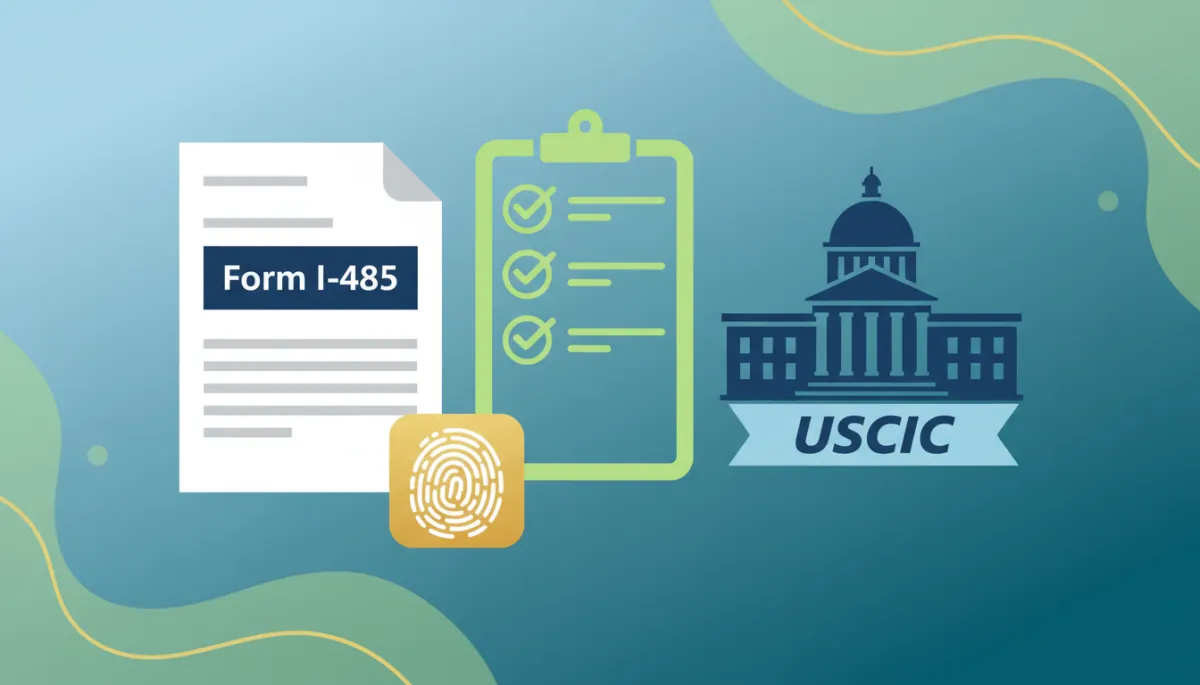
A clear step‑by‑step plan helps DFW families move confidently through the I‑485 process.
1. Confirm Your Eligibility and Visa Availability
Before filing, you or your representative should verify that a visa is available for your category using the Department of State Visa Bulletin and that you meet the admission, admissibility, and relationship requirements. This first step is critical; filing too early or under the wrong category can lead to rejection or denial, even in straightforward marriage‑based cases in Fort Worth.
2. Prepare and File Form I‑485 and Related Forms
The heart of your AOS case is Form I‑485, Application to Register Permanent Residence or Adjust Status. Many families also file:
- Form I‑130 (if not already approved) for family‑based cases
- Form I‑765 for a work permit and Form I‑131 for advance parole travel authorization
- Form I‑864 Affidavit of Support to show financial sponsorship
Your packet will also include supporting documents such as passports, I‑94 records, marriage and birth certificates, tax returns, pay stubs, and a sealed medical exam (Form I‑693). For families using an address in Tarrant County or nearby, the case is typically routed to a USCIS Dallas Fort Worth–area office after initial intake at a lockbox facility.
3. Attend Your Biometrics Appointment
A few weeks to a few months after USCIS receives your application, you will be scheduled for a biometrics appointment at a local Application Support Center, often in the Dallas–Fort Worth region. There, USCIS will take your fingerprints, photograph, and signature for background checks. Missing this appointment without rescheduling can seriously delay your case or lead to denial.
4. Respond to Any Requests for Evidence (RFE)
If something is missing or unclear, USCIS may send a Request for Evidence. This is common, especially in marriage‑based cases where officers want more proof that the relationship is real—joint leases in Fort Worth, shared utility bills, photos, and children’s school records, for example. Responding fully and on time is essential to keep your case on track.
5. Attend Your Adjustment of Status Interview
Most family‑based applicants will be scheduled for an in‑person interview at a local USCIS field office serving the DFW area. A USCIS officer will review your forms, ask about your background, and, in marriage cases, ask detailed questions about your relationship and daily life in Texas. Having your documents organized and being prepared to answer clearly and honestly can make the interview smoother and less stressful.
6. Receive a Decision and, If Approved, Your Green Card
After the interview, USCIS may approve your case, issue another RFE, or continue reviewing your file. Once approved, your green card is produced and mailed to your Texas address. For many families, this is the moment when years of uncertainty finally give way to stability and the ability to plan long‑term life in North Texas.
Typical Timeline for Adjustment of Status in the DFW Area
Processing times change frequently, but recent national data and community reports suggest that many family‑based AOS cases take roughly 8 to 17 months from filing to decision, with some cases moving faster and others taking longer. Employment‑based AOS can take 9 to 22 months or more, depending on whether the case is handled at a field office or a service center. These ranges are consistent with 2026 processing‑time summaries from independent trackers and USCIS reports.
In practice, families filing I‑485 in Fort Worth often see:
- Receipt notices within 2–4 weeks after mailing the packet
- Biometrics appointments within 1–4 months of filing, depending on USCIS workload
- Work permit and travel card approvals (if requested) around 4–8 months after filing, though this can vary
- Interviews and final decisions anywhere from 8 to 18 months or longer
These are averages, not guarantees. Some Texas applicants report approvals in as little as four months, while others wait much longer, especially when security checks or complex histories are involved.
Common Reasons for Delays or Denials
Understanding what can go wrong is as important as understanding the basic steps. Some of the most frequent issues that slow down or block Adjustment of Status Texas cases include:
- Incomplete or inconsistent forms – Missing signatures, incorrect dates, or conflicting information between I‑485, I‑130, and I‑864 can trigger RFEs or denials.
- Insufficient relationship evidence – In marriage‑based cases, weak documentation that a couple truly shares a life in Texas can lead to intense questioning or denial.
- Unresolved criminal or immigration issues – Certain arrests, prior deportation orders, or misrepresentations can make an applicant inadmissible unless a waiver is granted.
- Public‑charge concerns – With the 2026 rule change, heavy reliance on means‑tested benefits may raise red flags unless addressed carefully with financial evidence or, in some cases, a public‑charge bond.
- Missed notices or appointments – Families who move within DFW and forget to update their address with USCIS sometimes miss biometrics or interview notices, causing serious setbacks.
Practical Tips for DFW‑Area Families Filing Adjustment of Status
Families in Fort Worth, Dallas, and the surrounding cities face unique challenges—busy work schedules, long commutes, and sometimes mixed‑status households. The following local‑focused tips can help you navigate your case more smoothly:
- Plan around school and work schedules. Interview and biometrics appointments are usually during business hours. Talk with employers and schools in advance so you can attend without last‑minute stress.
- Keep a dedicated AOS folder. Store copies of every form, receipt notice, and RFE response, along with updated evidence like joint bank statements, lease renewals, and Texas driver’s licenses. This makes it easy to grab what you need if USCIS sends a notice or sets an interview quickly.
- Update your address promptly. If you move from, say, Haltom City to Burleson, file the required change of address with USCIS within 10 days so that critical mail is not sent to your old apartment complex.
- Coordinate immigration and tax planning. Because household income, tax returns, and sponsorship play a big role in AOS, many families benefit from working with a firm that understands both immigration and tax rules. This is especially important for self‑employed workers, rideshare drivers, and small‑business owners in the DFW area whose income may fluctuate from year to year.
Local, bilingual support can be especially comforting when you are making decisions that affect your family’s future in Texas. An experienced team can review your eligibility, prepare your I‑485 packet, and help you respond strategically to any USCIS questions, all while keeping an eye on upcoming policy changes and form updates.
Moving Toward Permanent Residence Without Leaving Texas
Adjustment of Status offers a powerful path for eligible immigrants who have built their lives in the Dallas–Fort Worth area and want to obtain a green card without leaving US soil. While the process can feel overwhelming—especially with evolving rules on public charge and the discretionary nature of AOS—many families succeed each year by approaching it with careful planning, honest disclosure, and strong documentation of their lives in North Texas.
Families navigating AOS in the Fort Worth area can find experienced guidance at ikartaxandinvestments.com, or stop by the office at 4200 South Fwy., Suite 2520, Fort Worth, TX 76115. Appointments can also be scheduled by calling (817) 305-3433, and you can learn more about the firm’s reputation by viewing IKAR Tax and Investments Inc on Google Maps.
